Who trains the next wave?
“The most valuable seat in your engineering team right now is the one you’re not filling.”
I’ve been quiet on here for a bit. Deliberately. The AI hype cycle has been deafening and I needed to step away from it before I had anything honest to say.
Coming back, I’ve been ruminating. It isn’t whether AI replaces us. I don’t believe it does, not for real engineering work. It’s what happens to the pipeline if we let the hype convince us we don’t need juniors any more.
🧠 Augmentation, not replacement
Let me get the obligatory take out of the way. I don’t see AI replacing software engineers. Not this generation of models, not the next one either.
What I see is augmentation. Faster scaffolding, better first drafts, less time wrestling with boilerplate, more time on the parts of the job that actually matter: design, judgement, communication, taste. The senior engineers I know are getting more productive. So am I.
That’s a good story if you’re already senior. It’s a much worse one if you’re eighteen and trying to break in.
⚠️ The uncomfortable maths
Look at how the argument tends to go in leadership meetings.
- Juniors are expensive to train
- AI can knock out the “junior work” faster
- So we hire fewer juniors and lean harder on our seniors
Every step in that chain is defensible on its own. Stack them together and you get an industry that stops making engineers.
That’s the bit nobody wants to say out loud. If everyone runs the same play, in five years we all wake up short of mid-levels, and there’s no cavalry.
🪜 “AI does junior work” is the wrong framing
The mistake in that argument is treating “junior work” as a category of tasks. It isn’t. Junior work is a stage of growth.
The scaffolding, the CRUD endpoints, the boring tickets: those weren’t valuable because they shipped features. They were valuable because they were how humans learned the shape of the system. Failing safely. Getting feedback. Building the intuition that makes a senior engineer worth their salary a decade later.
Automate the tasks and you don’t automate the growth. You delete it.
Junior work isn’t a category of task. It’s a stage of growth. Skip the stage and there’s no senior at the end of it.
🎯 What we actually owe the next wave
I keep coming back to this. If my generation of engineers benefited from being hired green, mentored, and given room to fail, the honest answer is we owe the same forward.
That doesn’t mean hiring juniors as charity. It means:
- Treating the junior seat as an investment, not a cost line
- Rethinking what juniors do in an AI-augmented team, not writing them out of it
- Pairing them with AI as a collaborator, not a substitute
- Being deliberate about the learning loop, because the accidental version is gone
The teams that get this right in the next two years will have a bench of mid-levels when everyone else is fighting over the same hundred people on LinkedIn.
🤖 One future worth building
Here’s the interesting bit. Juniors and seniors don’t use these tools the same way, and I don’t think we’ve properly reckoned with that yet.
When a senior engineer uses an AI coding tool, they use it as an accelerator. They already know what good looks like, so they can spot bad output at a glance and steer it. The tool multiplies what they’d have done anyway.
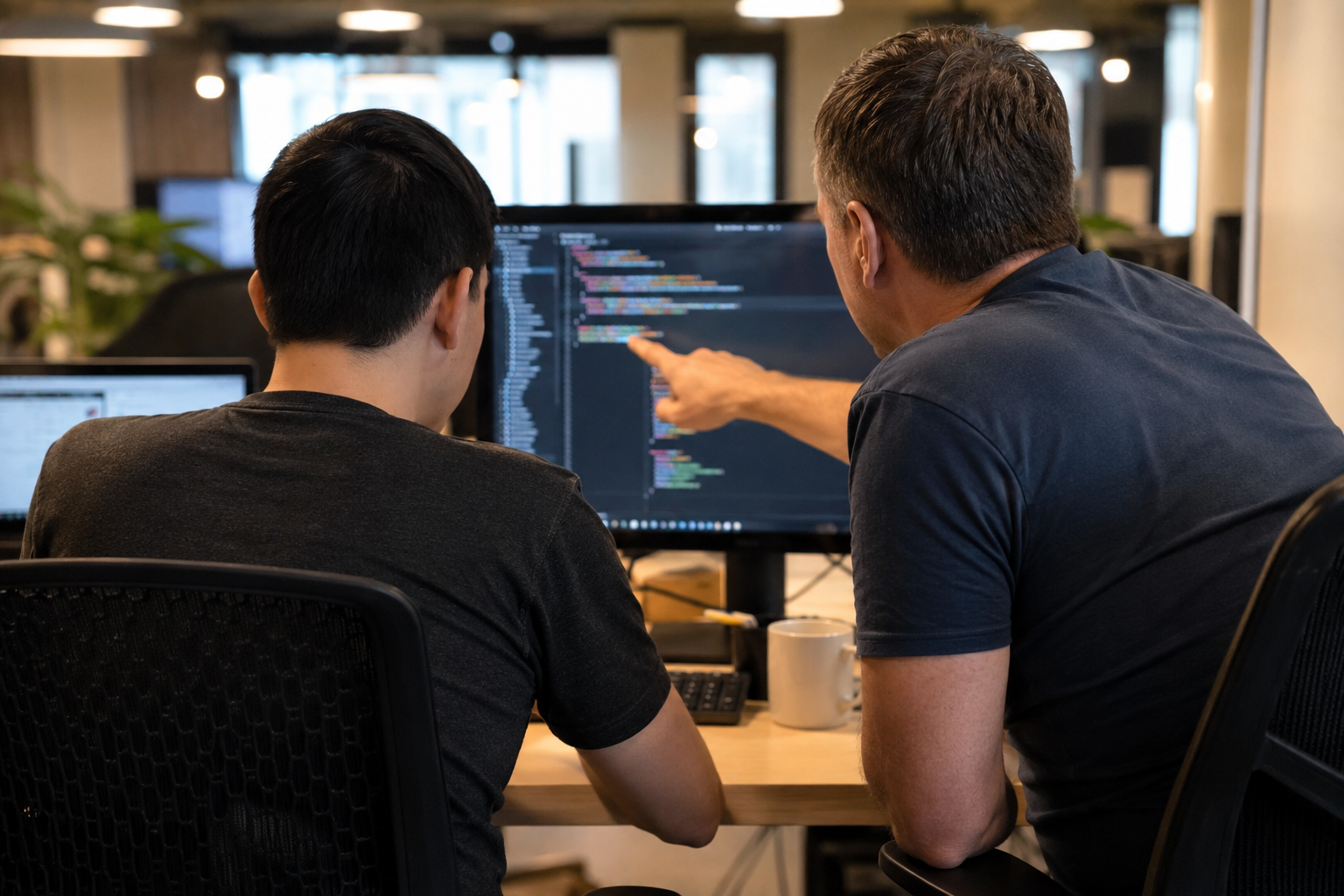
When a junior uses the same tool, something different happens. They don’t yet have the taste to know what’s wrong. So the tool either becomes a crutch that ships plausible-looking code without understanding, or it becomes a coach that walks them through the reasoning.
Today’s tools are optimised for the first case. They’re built for speed and autonomy, because the people paying for them are seniors who want output. Fair enough.
But there’s an obvious second product hiding in there. An agent tuned for coaching. One that slows a junior down at the right moments, asks “what do you think happens if this input is null”, surfaces the tradeoffs a senior would have voiced over their shoulder, refuses to hand the answer over on a plate.
That’s not replacing mentorship. That’s augmenting it. Freeing senior engineers from the obvious coaching so they can focus on the harder judgement calls only a human can make.
If we get that right, AI stops being the excuse to skip juniors and becomes part of how we train them at scale.
🔁 A quieter ask
I’m not writing this to be dramatic. I’m writing it because I’ve had three conversations in the last month with people who quietly admitted they’d paused junior hiring “until things settle down.”
Things aren’t going to settle down. This is the shape of the industry now. The choice is whether we keep training people through it, or whether we let the pipeline dry out and pretend that’s someone else’s problem.
— Shane