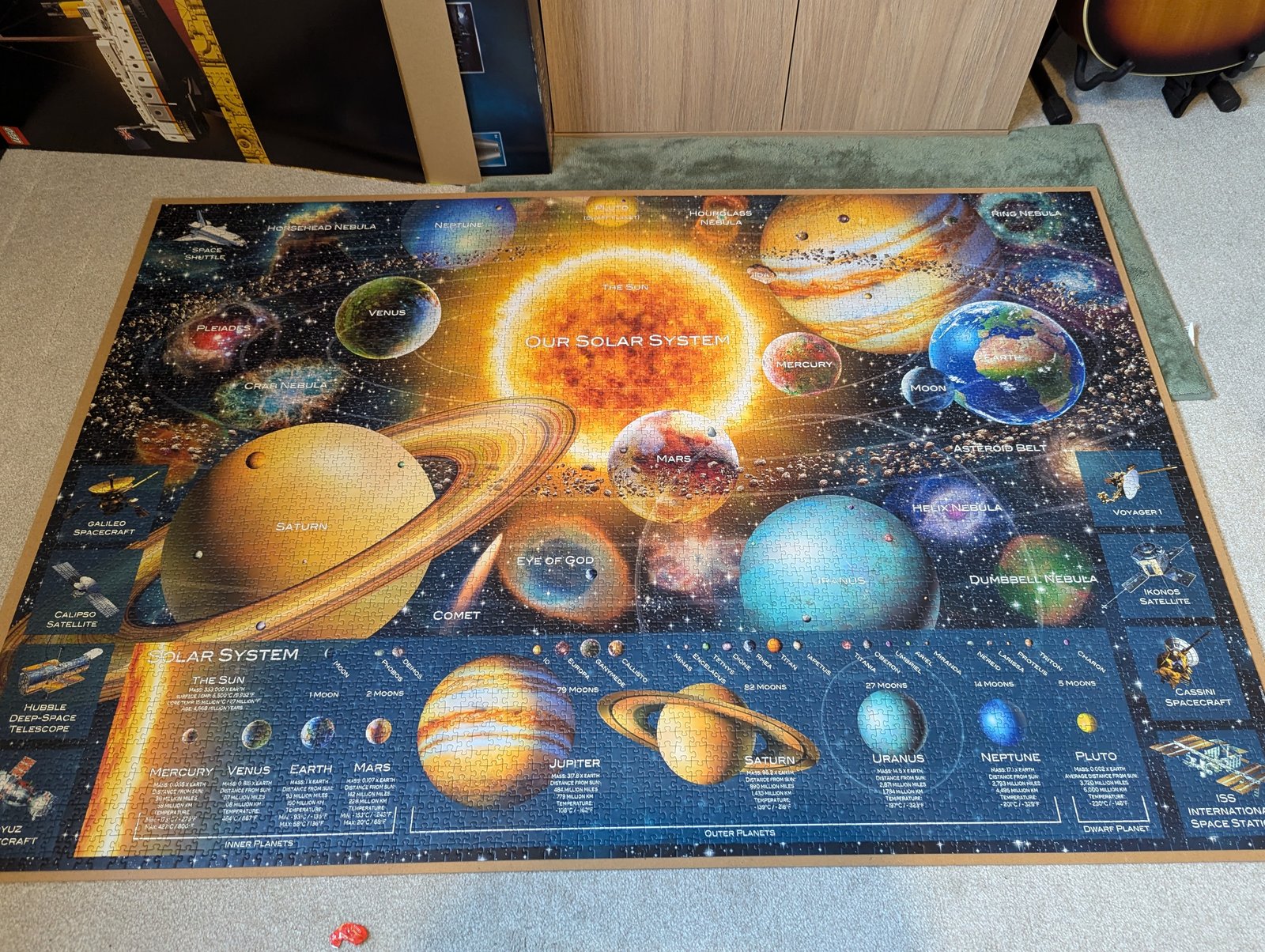
5,000 Pieces of the Solar System
Eleven days. 5,000 pieces. Zero missing.
I picked up a “Our Solar System” jigsaw a while back and finally got round to it. The board is about a metre and a half wide so it takes over the room, but that’s part of the deal.
Here’s how it came together.
🌑 Day 1: Tip it out, sort the edges
20th April
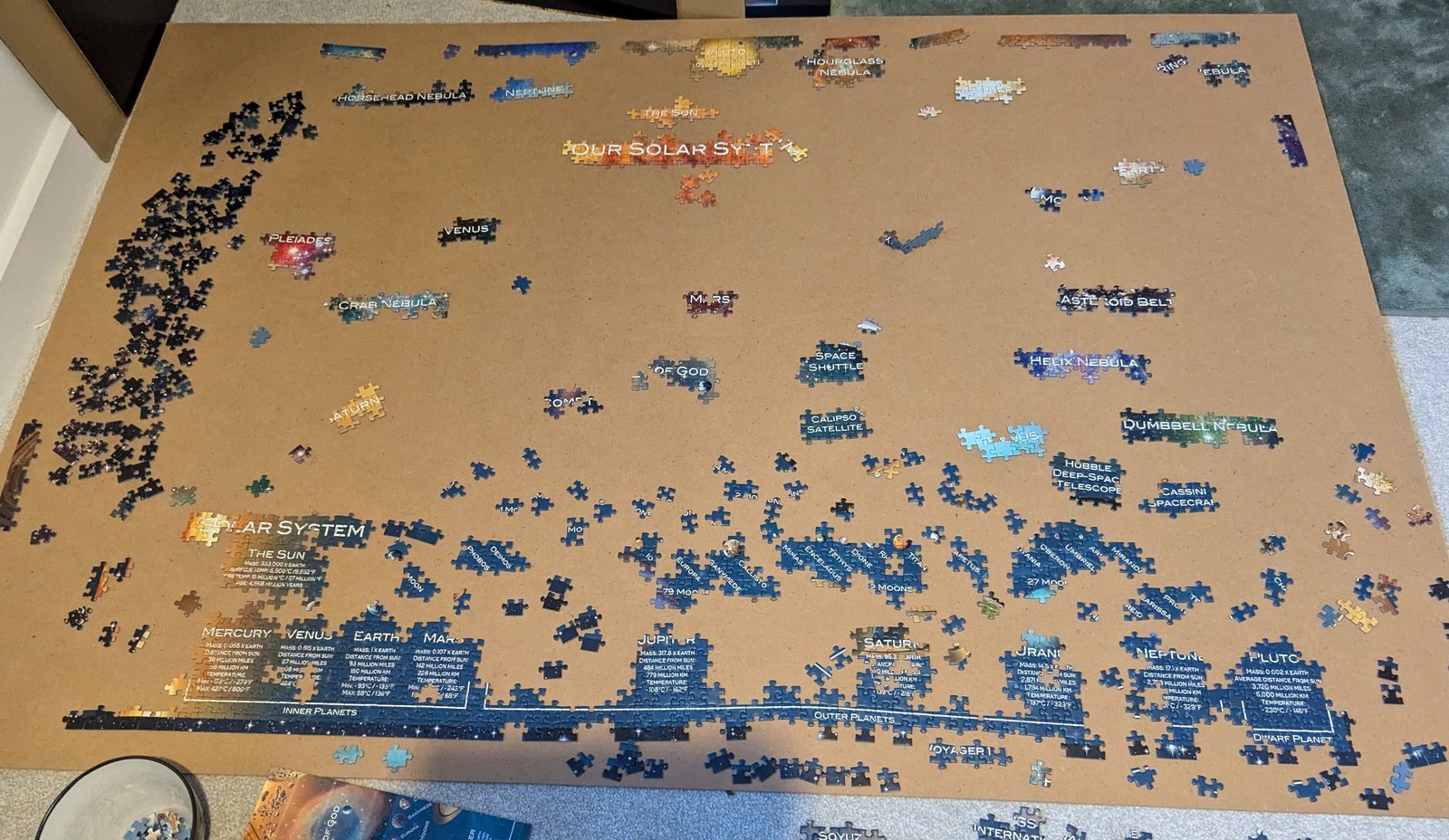
First job: edges, and pulling out anything with text on it. The puzzle has a lot of labelled sections: planet names, infographic panels: so those pieces are easy to spot and worth separating early. Everything else went into rough colour piles.
🔭 Day 2: Frame done, infographics next
21st April
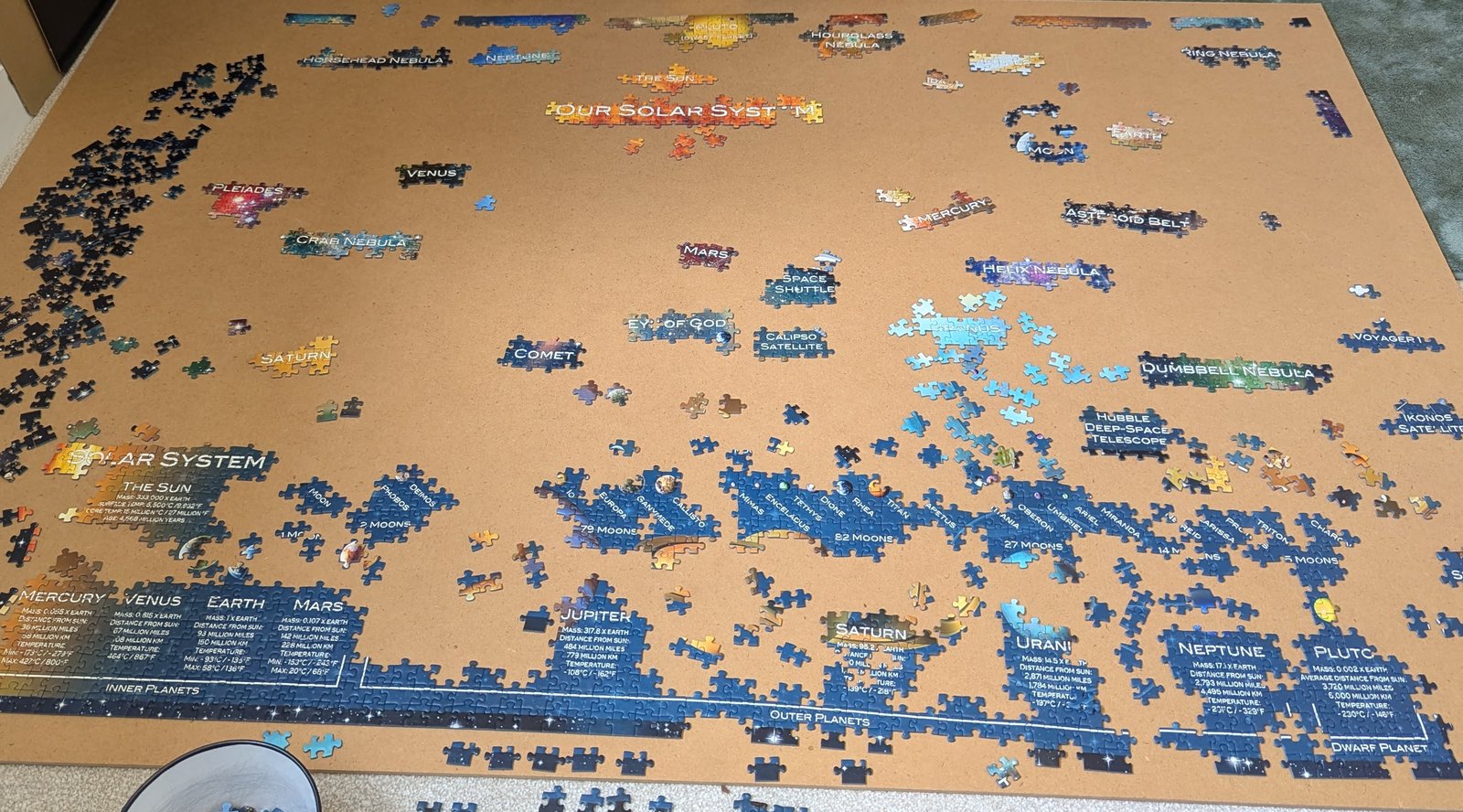
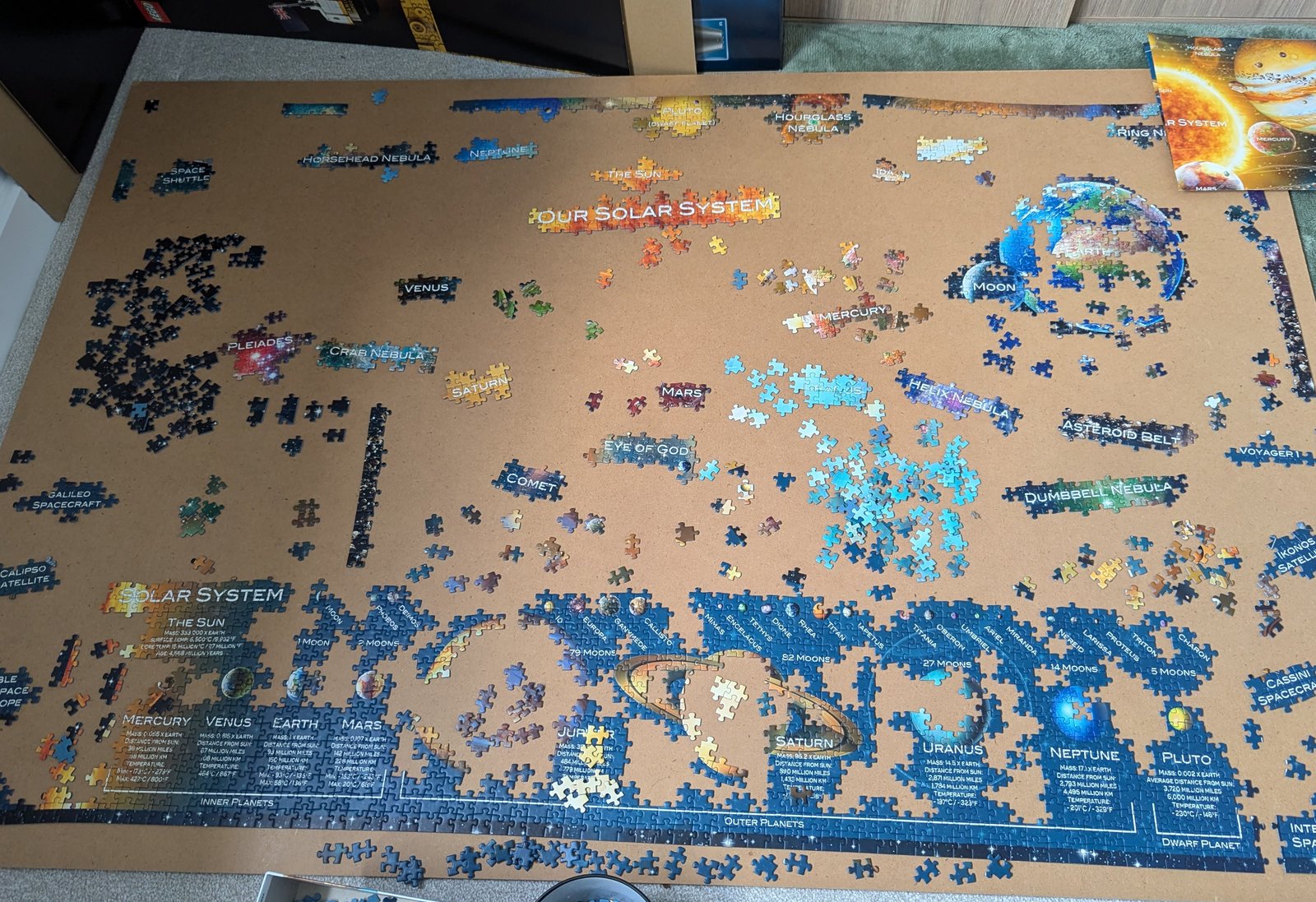
With the frame in, the infographic strip along the bottom was the obvious next target: it’s got enough contrast and text to make progress feel quick. By the evening Earth was starting to take shape in the top-right, which gave a useful anchor for the surrounding pieces.
🌍 Day 3: Planets starting to form
22nd April
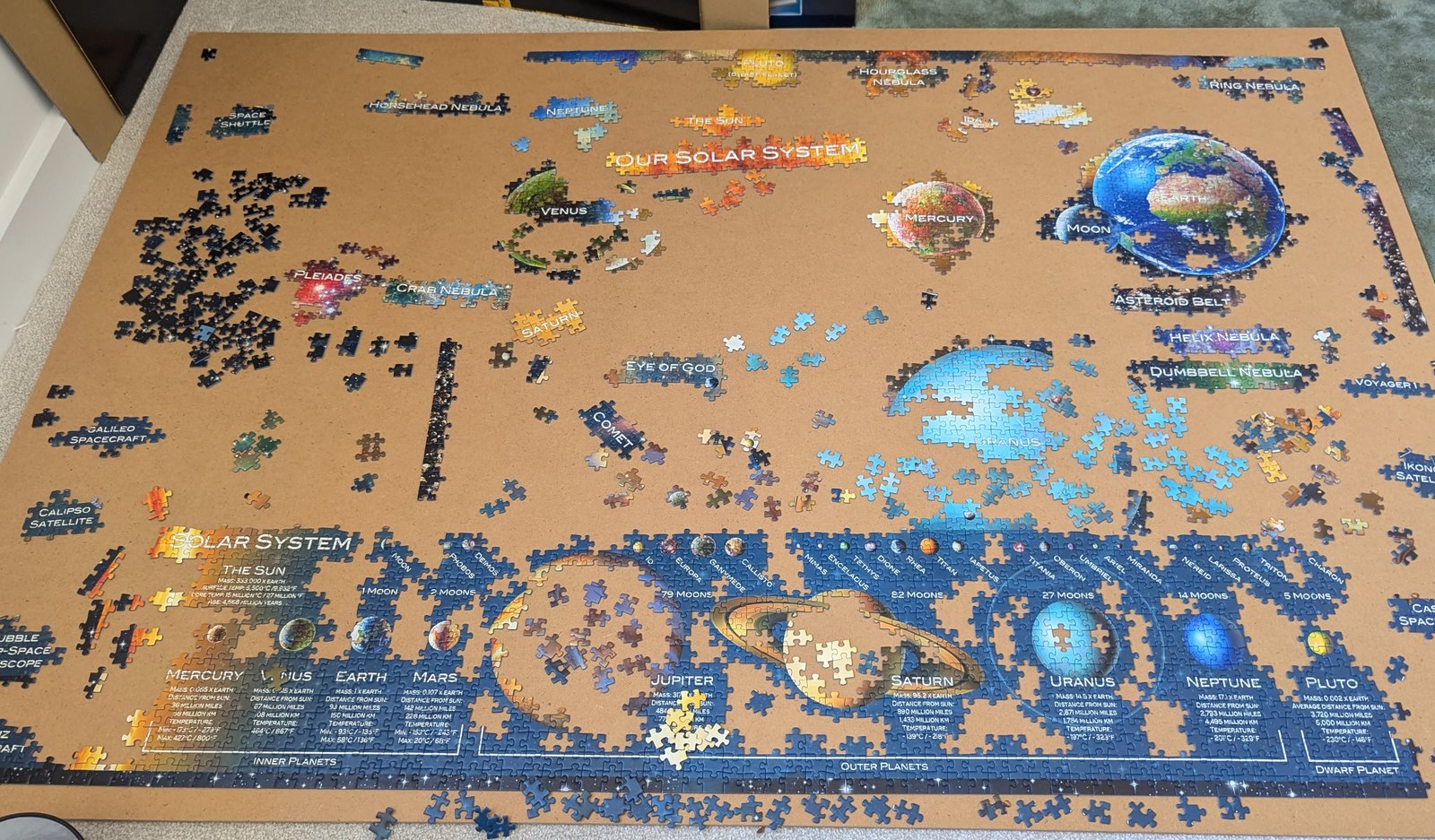
Earth fully in. Venus starting to appear. Once the distinctive planetary colours are on the board you’ve got reference points to build outward from: everything gets a bit more manageable from here.
☄️ Day 4: Building momentum
23rd April
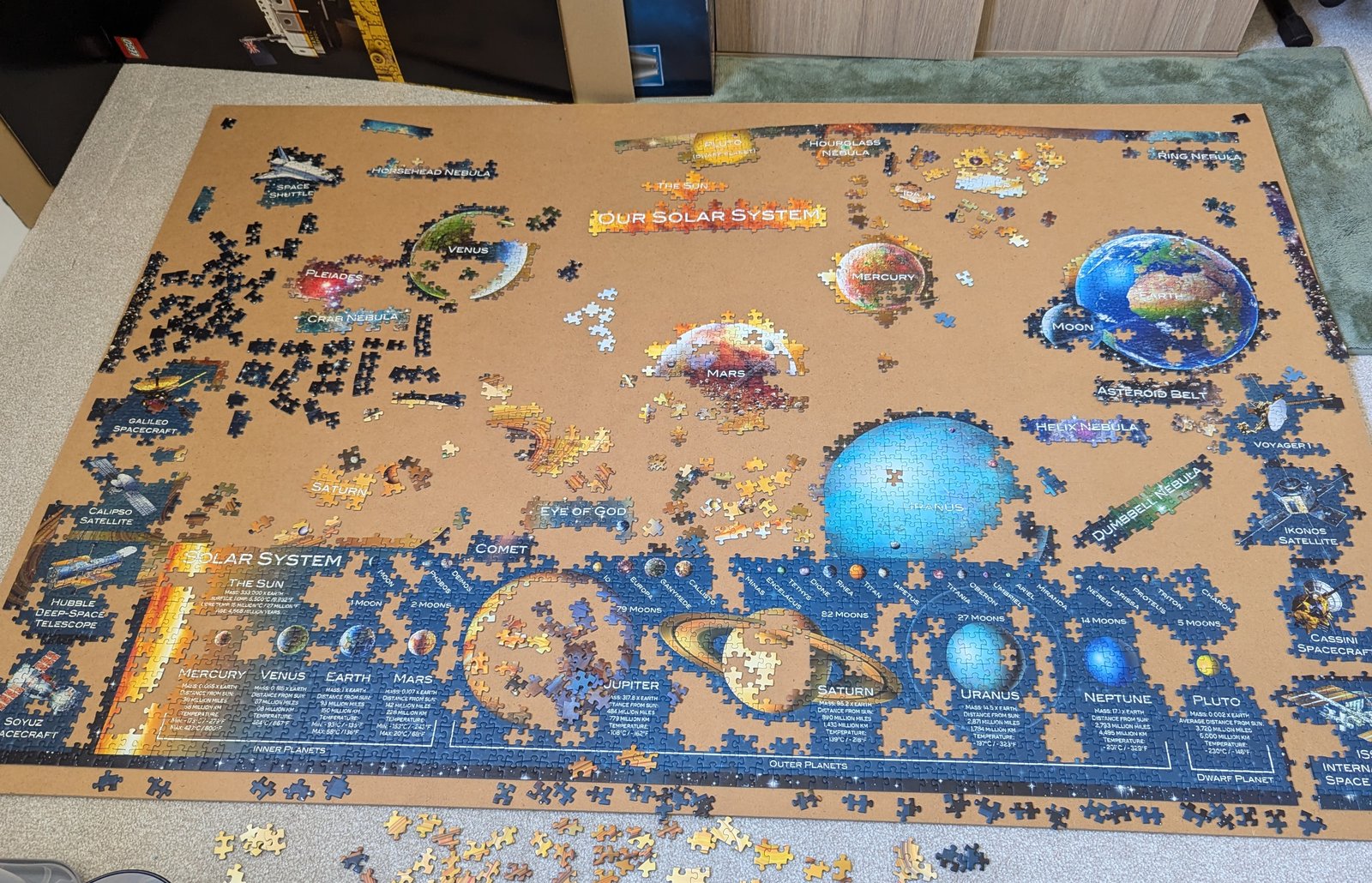
A good session. Several more planets solidifying, the asteroid belt label sitting in the middle where it belongs, and the outer planets beginning to emerge on the right side.
🪐 Day 5: Saturn, Jupiter, and the Sun problem
24th April
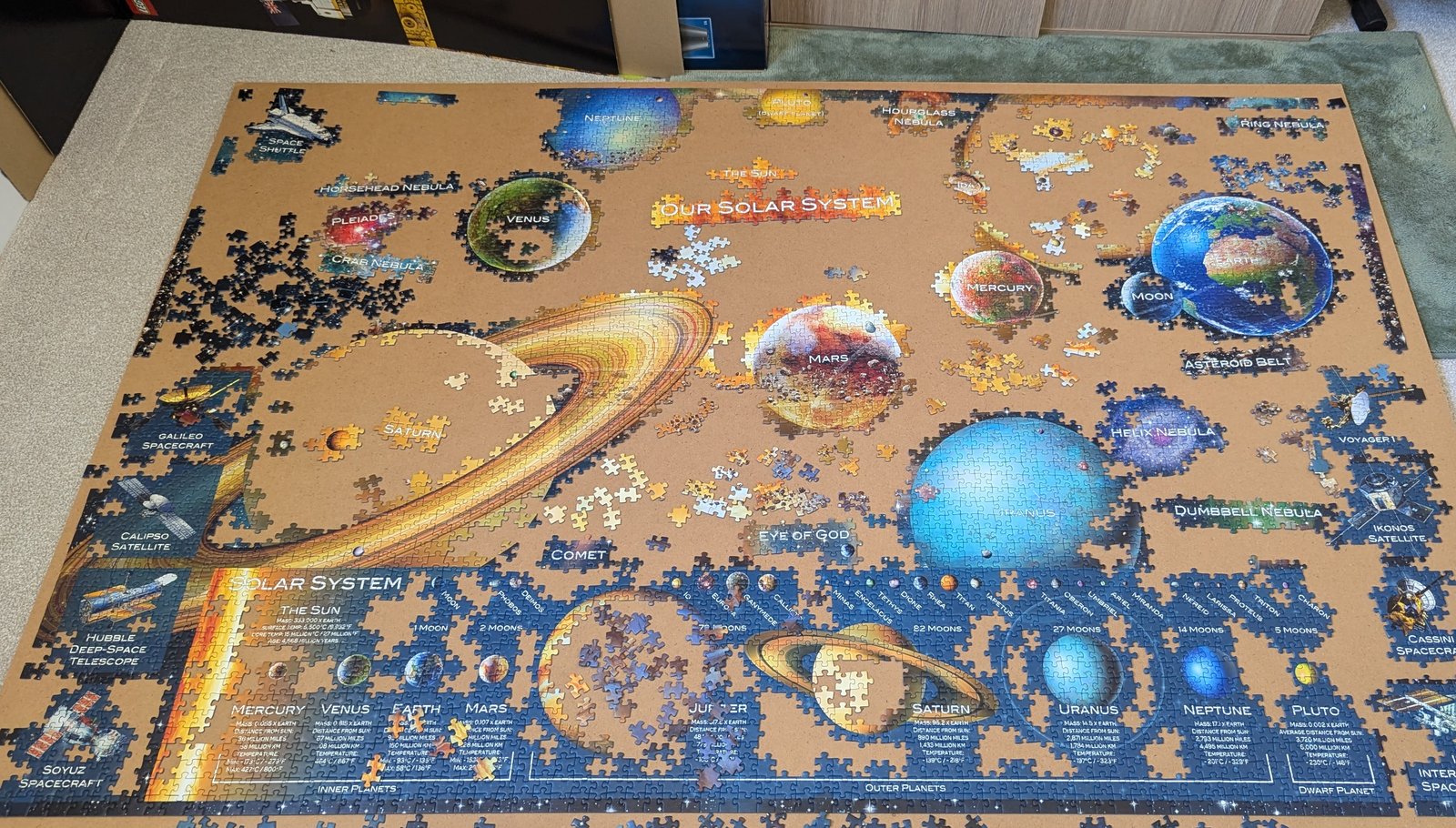
Saturn was an interesting one: it shares a lot of colour with the Sun, both being warm oranges and yellows. The approach that worked was getting the rings in first (they have a distinctive gradient and angle), then filling the body. Jupiter went in alongside it.
While working on those, the Sun pieces were being kept separate: there are a lot of them and they needed their own pile to avoid confusion with Saturn.
☀️ Day 7: Vessels and the Sun
26th April
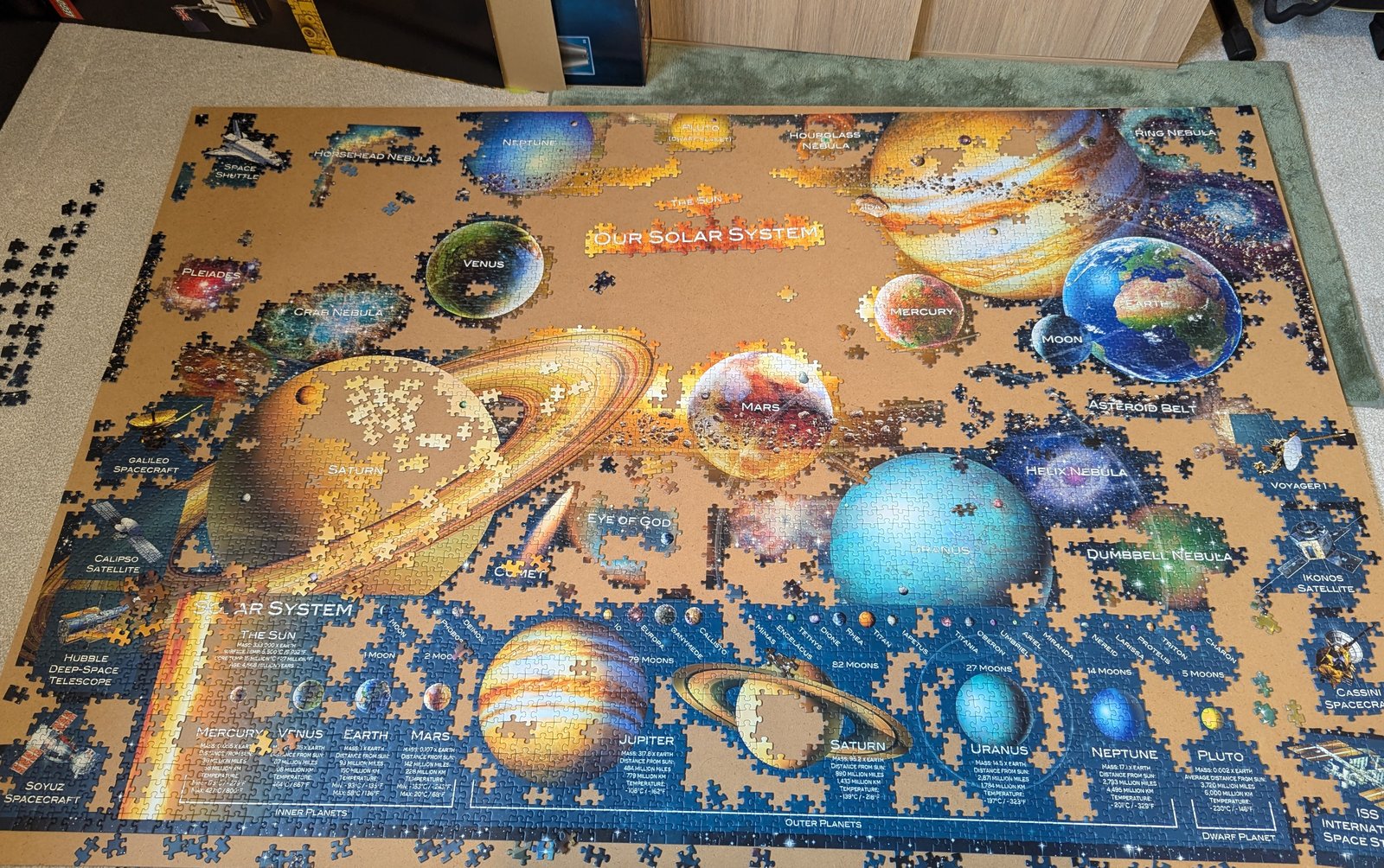
The spacecraft and other vessels: the ISS, Hubble, various probes: got done around this point, along with the Sun itself. The Sun is a big section and quite uniform in parts, but with the Saturn confusion avoided earlier it went in steadily.
🌌 Day 8: Nebulae and asteroids
27th April
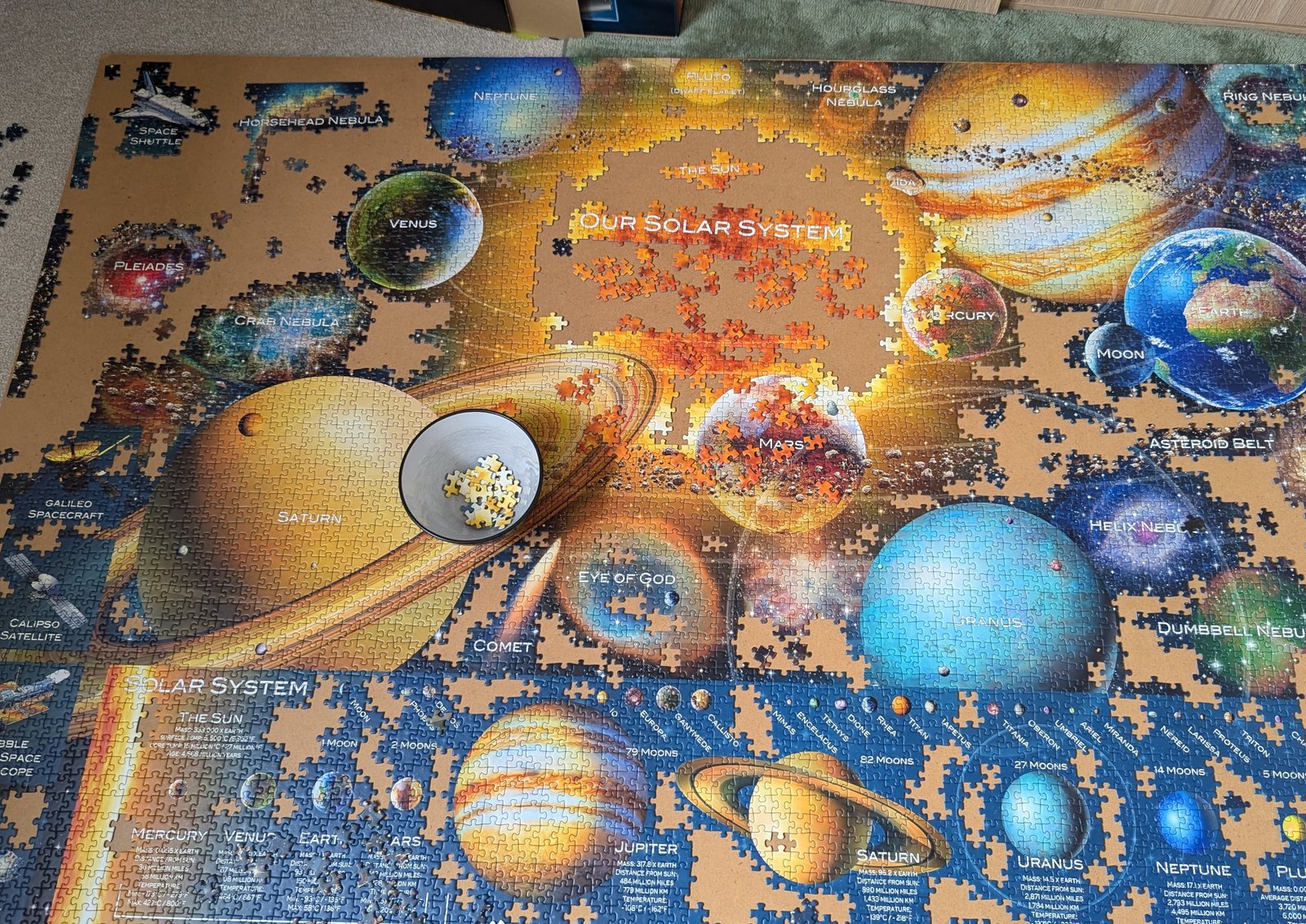
With the main features done, it was down to the nebulae and the asteroid regions. The asteroids were actually harder than expected: small, dark, not a lot to distinguish one piece from another.
✨ Days 9–10: The star fields
28th–29th April
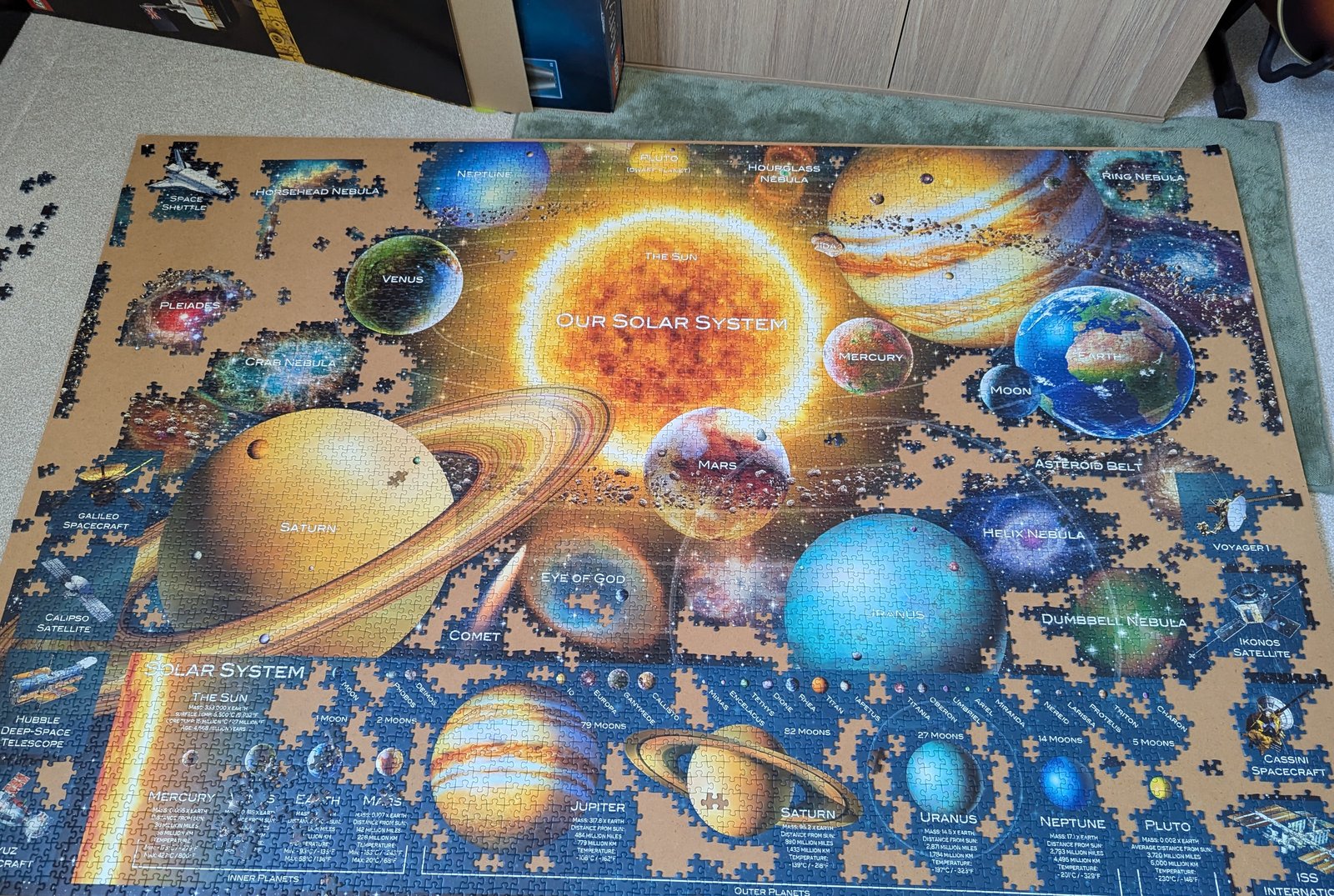
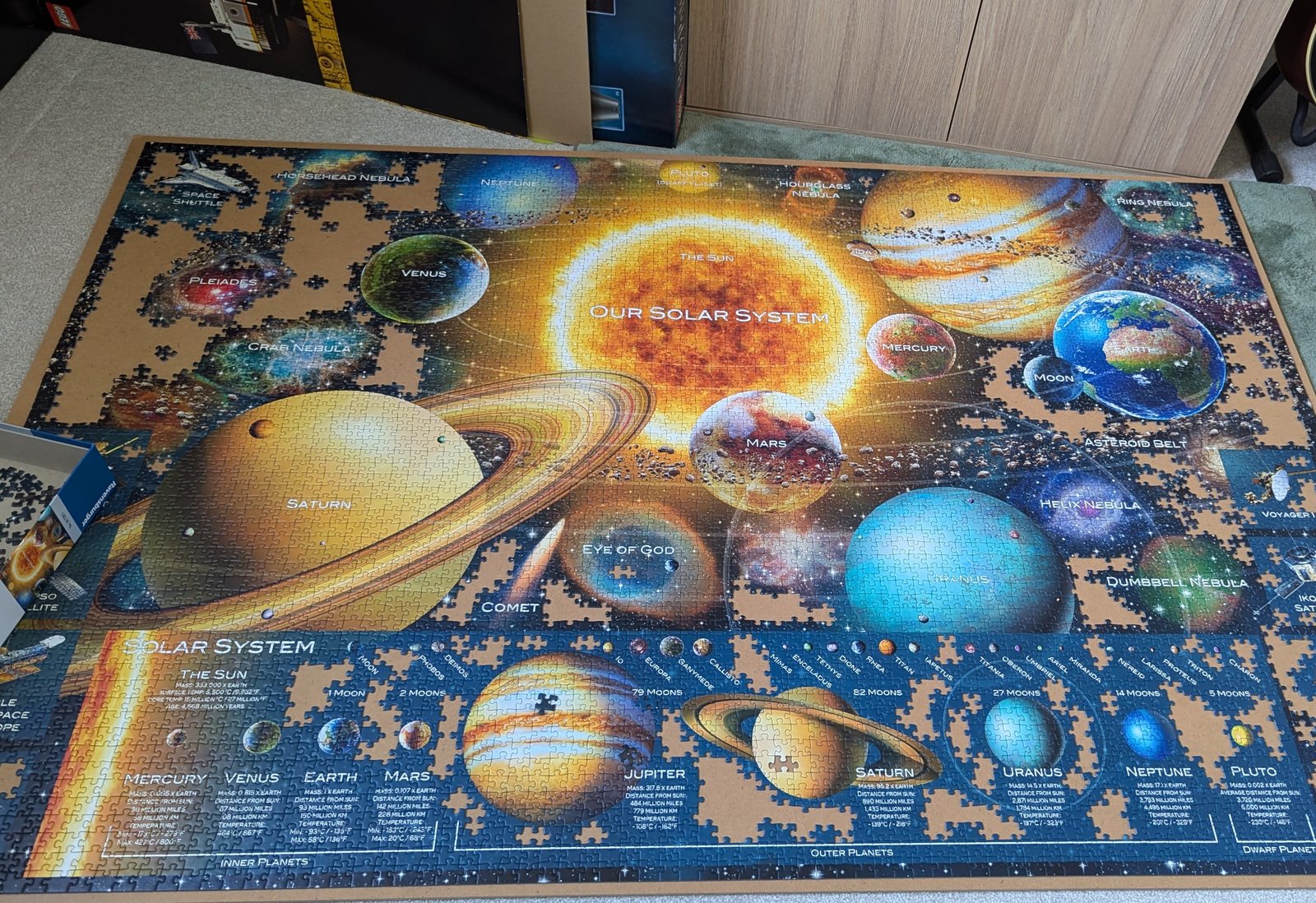
Last up: the star fields. These got split into two groups: the slightly blueish pieces that belong to the infographic sections at the bottom, and the darker pieces for the rest of the background. That separation made it workable. Without it you’d just be guessing.
It’s slow going but there’s not much else to do except work through it systematically.
🎉 Done
1st May
Eleven days. No missing pieces.
The full solar system from Mercury out to Pluto, plus the ISS, Hubble, various comets and nebulae, and a thorough infographic along the bottom that I now know better than I ever expected to.
Now it’s sitting on the board in the corner and I have no idea what to do with it.
Shane 🪐
“The heavens declare the glory of God; the skies proclaim the work of his hands.” (Psalm 19:1)